Struggling middle managers often become easy targets for criticism. Common assumptions quickly follow. They are not proactive enough. They do not take ownership. They are not strong leaders.
Leadership requires a more important question before assigning blame.
Did you truly set them up to succeed?
A confident answer supported by clear examples reflects intentional leadership. Uncertainty or a lack of evidence may reveal that their struggles are not solely their responsibility.
Leadership development begins at the top. Organizations have the power to create environments where middle managers either thrive or struggle.
Success is not accidental. Failure is rarely accidental either.

They Do Not Have Your Perspective, Yet You Expect Them To
Senior leaders operate with a broad understanding of business strategy, market conditions, organizational priorities, political dynamics, and long-term objectives.
Middle managers rarely have access to that same perspective.
Most spend their time managing day-to-day operations while balancing competing priorities and solving immediate challenges.
The Problem
Senior leaders often assume information is obvious simply because they possess it.
Middle managers cannot make strategic decisions without understanding the reasoning behind those decisions.
The Solution
Share more than instructions.
Explain the purpose behind strategic decisions, organizational priorities, and business objectives. Greater context leads to stronger judgment and better decision-making.
Understanding the “why” creates stronger leaders.
They Lack Political Awareness Because No One Taught Them
Every organization has informal rules that influence decision-making.
Experienced leaders learn how to navigate relationships, competing priorities, influence, and organizational politics over time.
Middle managers are often expected to discover those lessons through trial and error.
The Problem
Limited political awareness leaves middle managers vulnerable to unnecessary mistakes and missed opportunities.
The Solution
Teach organizational dynamics openly.
Help middle managers understand stakeholder management, influence, communication, and relationship building. Guidance in these areas strengthens both confidence and effectiveness.
You Promoted Them Without Teaching Them How to Lead
Technical excellence and leadership capability are not the same.
High-performing individual contributors frequently receive promotions because they excel in their current roles. Leadership responsibilities require an entirely different set of skills.
The Problem
Promotion decisions often reward technical expertise without preparing individuals for leadership responsibilities.
The Solution
Leadership development should begin immediately after promotion.
Provide coaching, mentoring, structured leadership training, and consistent feedback. Strong leaders are developed through intentional investment rather than expectation alone.
You Expect Results Without Providing Resources
Every organization expects performance.
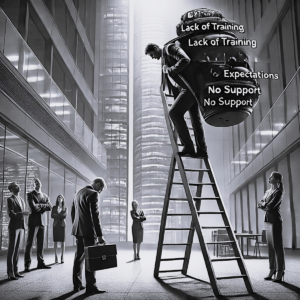
Outstanding performance becomes difficult when expectations continue to increase while support remains limited.
The Problem
Unrealistic workloads, limited staffing, insufficient budgets, and inadequate time create conditions where success becomes increasingly difficult.
High expectations without meaningful support often produce frustration instead of results.
The Solution
Provide the resources necessary for success whenever possible.
People, time, budget, and organizational support allow managers to perform at a higher level. Expectations should align with the resources available when additional support cannot be provided.
Leaders should never expect exceptional outcomes while creating impossible conditions.
Leadership Starts at the Top
Middle managers rarely fail in isolation.
Leadership systems, organizational culture, communication, and executive support all shape their ability to succeed.
Effective middle managers require more than responsibility. They need direction, development, resources, coaching, and trust.
Strong leadership begins by asking a difficult question.
Have I truly given my managers everything they need to succeed?
An honest answer creates an opportunity for meaningful improvement.
Intentional leaders recognize that developing middle managers is not an additional responsibility.
Developing leaders is one of the most important responsibilities leadership has.